

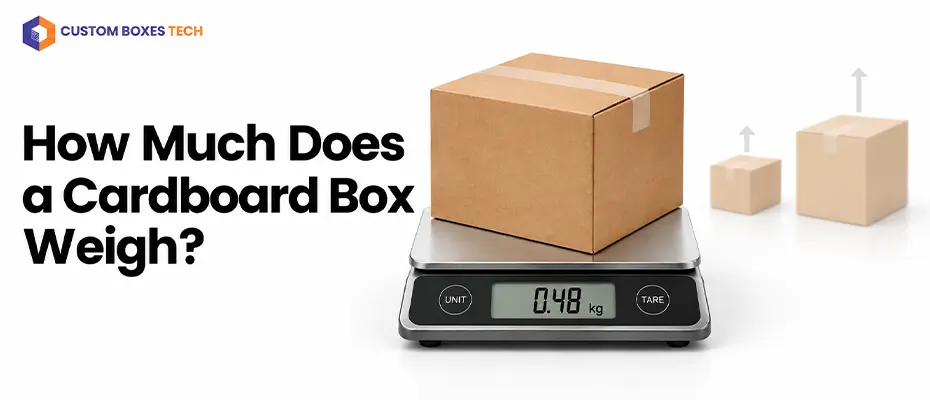
A cardboard box may feel light, but its weight can matter a lot during packing and shipping.
The box adds to the total package weight. It can affect shipping cost, storage, lifting, freight planning, and material use.
So, How Much Does a Cardboard Box Weigh? There is no single weight for every box.
A small corrugated cardboard box may weigh only a few ounces. A large or heavy-duty carton may weigh several pounds.
Understanding Cardboard Box Weight by Size, Board Type, and Design
Size makes a difference, but many other things also affect weight. These include board GSM, flute type, box style, wall type, paper grade, glue, printing, coatings, moisture, and inserts.
The easiest way to get the exact weight is simple:
Place the finished empty box on a scale.
If you need an estimate before production, you can calculate the weight from the box area and board weight.
How Much Does an Empty Cardboard Box Weigh?
An empty cardboard box can weigh from a few ounces to several pounds.
Small boxes use less board, so they often weigh less. Large boxes use more material and usually weigh more.
A single-wall box will also weigh less than many double-wall boxes of the same size.
The table below gives estimated weights for cube-shaped regular slotted cartons. The examples use about 497 GSM corrugated boards.
Inside Box Size | Estimated Empty Weight | Approx. Metric Weight |
|---|---|---|
6 × 6 × 6 in | 0.22 lb | 0.10 kg |
8 × 8 × 8 in | 0.38 lb | 0.17 kg |
10 × 10 × 10 in | 0.59 lb | 0.27 kg |
12 × 12 × 12 in | 0.84 lb | 0.38 kg |
16 × 16 × 16 in | 1.48 lb | 0.67 kg |
18 × 18 × 18 in | 1.87 lb | 0.85 kg |
20 × 20 × 20 in | 2.30 lb | 1.05 kg |
24 × 24 × 24 in | 3.31 lb | 1.50 kg |
These numbers give useful estimates. Do not treat them as fixed weights.
Changes in paper grade, flute, glue, box design, or coatings can change the final result.
What Does “Cardboard Box” Mean?
People often use the word "cardboard" for several types of paper-based packaging.
However, many shipping boxes use corrugated cardboard rather than simple paperboard.
Corrugated boards usually have two flat paper liners with a wave-shaped paper layer between them.
That wave-shaped layer is the fluting medium.
Paperboard, such as the material used for many small retail cartons, usually has no fluted center.
This difference matters because board construction changes both weight and strength.
A thin folding carton may weigh far less than a corrugated shipping box of the same outside size.
What Types of Box Weight Matter?
“Box weight” can mean several things.
Knowing the right type helps you avoid errors when you plan shipping or freight.
Weight Type | What It Means |
|---|---|
Tare weight | Weight of the empty box and packing parts |
Net weight | Weight of the product alone |
Gross weight | Product plus box and all packing material |
Palletized weight | Boxes, products, pallets, wraps, and straps |
Dimensional weight | Shipping value based on package size |
If you only want to know how much the cardboard carton weighs, look at the tare weight.
For shipping, you usually need the gross weight.
For pallet or freight work, you may also need the full pallet load.
What Changes the Weight of a Cardboard Box?
Many factors can change the final carton weight.
Two boxes with the same length, width, and height may still weigh different amounts.
Box Size
Large boxes need more board.
More board means more weight.
A 24-inch cube needs far more material than a 6-inch cube.
Board GSM
GSM means grams per square meter.
It tells you how much one square meter of material weighs.
A 600 GSM board normally weighs more than a 400 GSM board when both sheets have the same area.
Wall Structure
Corrugated boxes can use one or more fluted layers.
A single-wall box uses:
2 liners + 1 fluted medium
A double-wall box uses:
3 liners + 2 fluted mediums
A triple-wall box uses:
4 liners + 3 fluted mediums
More layers usually mean more weight.
Flute Type
The flute forms the wave inside the corrugated board.
Common types include:
A flute
B flute
C flute
E flute
BC flute
EB flute
Different flute shapes use different amounts of paper.
Flute Type | Approx. Take-Up Factor |
|---|---|
A flute | 1.50–1.55 |
B flute | 1.30–1.35 |
C flute | 1.40–1.45 |
E flute | 1.20–1.35 |
A C-flute factor of 1.43 means that 1 m² of finished board may need about 1.43 m² of fluting paper.
Paper Grade
Two boards can have the same thickness but use different paper weights.
Heavier liners and stronger paper grades can increase the final mass.
Box Style
Box style also matters.
A regular shipping carton, mailer, tray, sleeve, or die-cut box may use a different amount of material even when the inside space looks similar.
A design with large flaps needs more board.
Glue
Glue adds some weight.
The amount may look small for one carton, but it can matter when you calculate thousands of boxes.
Printing
Ink also adds a little weight.
Most simple printing adds only a small amount.
Heavy print coverage or an extra printed paper layer can add more.
Coatings and Lamination
A coating may add only a small amount of mass.
Film lamination, extra paper wraps, and other layers can add more.
Inserts
Corrugated inserts, dividers, pads, and paperboard supports add to total packaging weight.
They can also improve product safety.
Moisture
Paper can take in moisture from the air.
A box stored in a humid place may weigh slightly more than the same box in a dry place.
This means real weight may vary a little from a paper calculation.
Single-Wall vs Double-Wall vs Triple-Wall Weight
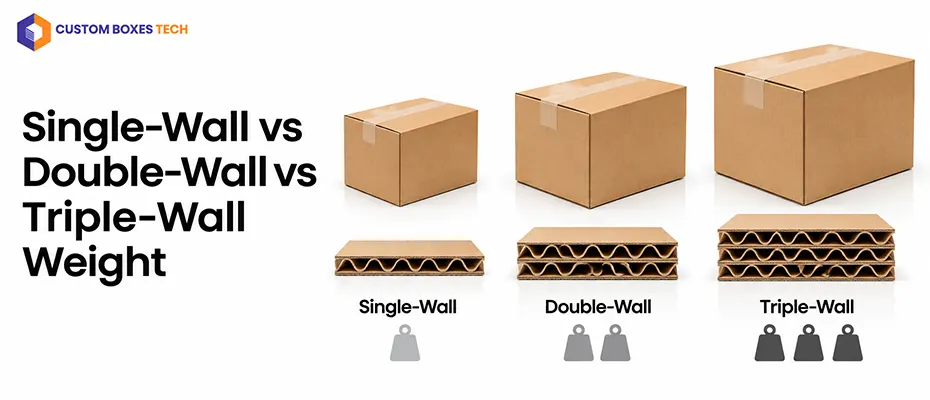
Wall type can change both weight and strength.
Board Type | Construction | Weight Effect | Common Use |
|---|---|---|---|
Single wall | 2 liners + 1 flute | Usually lightest | General shipping |
Double wall | 3 liners + 2 flutes | Heavier | Fragile or larger goods |
Triple wall | 4 liners + 3 flutes | Usually heaviest | Heavy industrial goods |
Do not assume that every double-wall box weighs a set percentage more.
Paper grade, flute mix, and liner weight can all change the result.
For an exact figure, check the full corrugated board specification.
How to Calculate Cardboard Box Weight
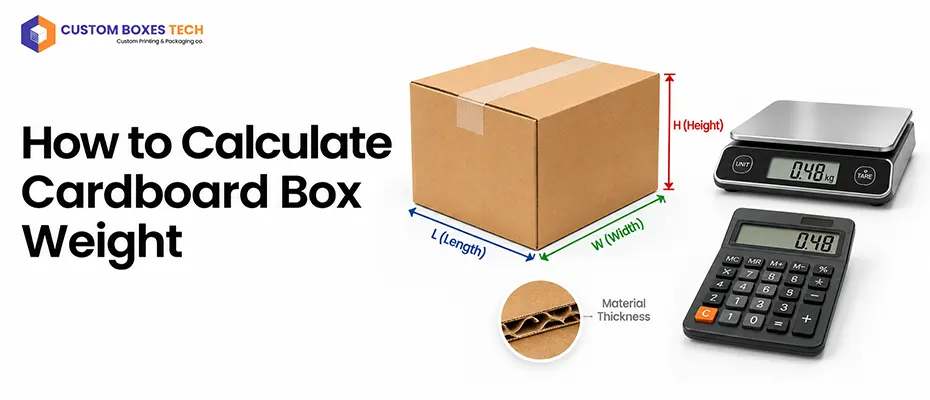
For the best result, weigh the finished carton.
For an early estimate, use this formula:
Estimated box weight = blank area × board grammage
If the blank area is in square meters and the board uses GSM, the answer comes out in grams.
Step 1: Find the Flat Blank Size
For a simple regular slotted carton, you can start with:
Blank length ≈ 2 × (Length + Width) + manufacturer’s joint
Blank width ≈ Height + Width
A box maker may add extra material for cuts, folds, scores, trim, and the glue joint.
Step 2: Find the Blank Area
Multiply:
blank length × blank width
Make sure you use the same unit for both figures.
Convert the final area into square metres before you apply GSM.
Step 3: Multiply by Board GSM
Take a 12 × 12 × 12-inch box.
Its estimated blank area may reach about:
0.766 m²
Now use the 497 GSM board.
The calculation becomes:
0.766 × 497 = about 381 grams
That equals about:
0.38 kg
13.4 oz
0.84 lb
So, this 12-inch cube may weigh about 0.84 lb when empty.
The real figure can change with the board and box design.
Corrugated Board Weight Example
Consider a regular slotted carton that measures:
575 × 385 × 225 mm
It uses a C-flute corrugated board.
The combined board weight reaches about 560 GSM.
A carton made from this type of board may weigh around 650 grams, depending on the blank design and production allowance.
The board may contain:
Board Component | Material Weight |
|---|---|
Outer liner | 175 GSM |
Corrugating medium | 140 GSM before flute adjustment |
Inner liner | 175 GSM |
Adhesive | About 10 GSM |
Combined board | About 560 GSM |
You cannot simply add the flat paper weights.
The flute uses extra paper because it forms waves.
With a C-flute take-up factor of 1.43:
140 × 1.43 = about 200 GSM
The combined board estimate becomes:
175 + 200 + 175 + 10 = about 560 GSM
This gives you a better picture of the real board weight.
Measure the Box Correctly Before You Calculate
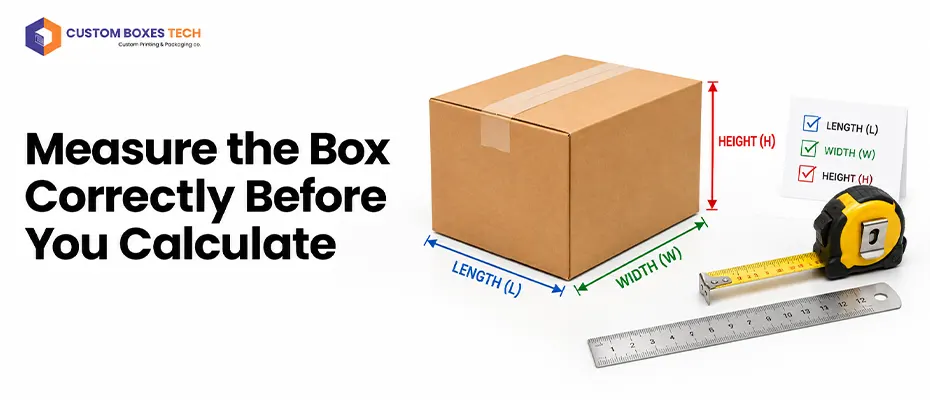
Wrong measurements can lead to a wrong weight estimate.
Measure Box dimensions often follow this order:
Length × Width × Height
You should also know whether the figures show inside dimensions or outside dimensions.
Inside dimensions describe the usable space in the carton.
Outside dimensions include the thickness of the board.
Do not mix inside and outside measurements in the same calculation.
The flat blank gives the best starting point because it shows how much board the box actually uses.
Actual Weight vs Dimensional Weight
Actual weight and dimensional weight mean different things.
Actual weight tells you how heavy the parcel really is.
A scale gives you this number.
Dimensional weight looks at the amount of space the parcel uses.
A shipping formula may look like:
Length × Width × Height ÷ dimensional divisor
For example, a 12 × 12 × 12-inch carton has a volume of:
1,728 cubic inches
If a shipping calculation uses a divisor of 139:
1,728 ÷ 139 = about 12.4 lb
That does not mean the empty cardboard box weighs 12.4 lb.
The carton itself may weigh less than one pound.
The 12.4 lb figure relates to shipping space, not the real mass of the cardboard.
How Printing and Finishing Affect Box Weight
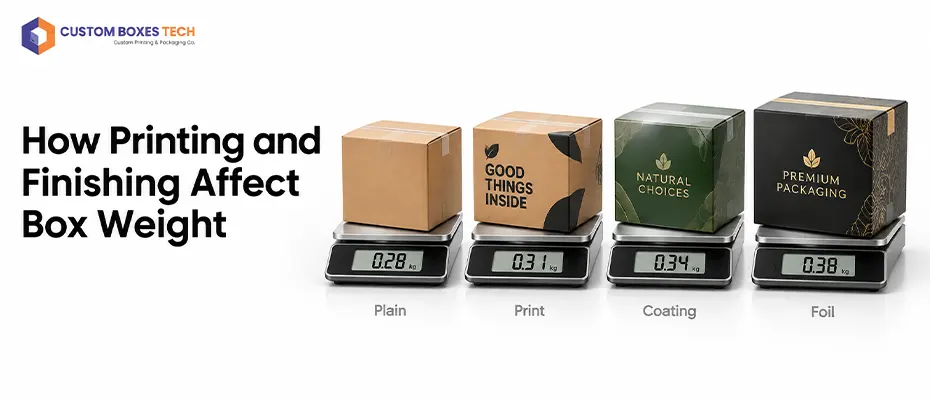
Printing usually adds little mass, but some print and finish methods add more than others.
Option | Weight Effect |
|---|---|
Simple ink printing | Usually small |
Digital printing | Usually small |
Printed paper layer | More noticeable |
Water-based coating | Small |
UV coating | Small |
Film lamination | Adds film and adhesive |
Foil | Usually minor |
Paper wrap | Can add noticeable weight |
Window patch | Depends on size |
Do not choose a print or finish method only by weight.
Think about product needs, print quality, protection, cost, and appearance.
Does a Heavier Box Mean a Stronger Box?
Not always.
More paper can add strength, but weight alone cannot tell you how well a carton will perform.
Corrugated box strength also depends on:
paper quality
fibre quality
flute design
wall type
ECT rating
compression strength
carton shape
score lines
box joints
stacking
humidity
handling
A well-made light carton may protect a product better than a poorly designed heavy carton.
Choose the board based on the product and shipping conditions, not weight alone.
Common Cardboard Box Sizes and Weight Needs
Different sizes work for different goods.
Box Size | Common Use | Weight Note |
|---|---|---|
6 × 6 × 6 in | Mugs and small items | Very little board |
8 × 8 × 8 in | Small goods | Usually light |
12 × 9 × 6 in | Clothes and kits | Medium board area |
12 × 12 × 12 in | General goods | About one cubic foot |
18 × 14 × 10 in | Larger products | Uses more board |
20 × 16 × 14 in | Bulky goods | Board grade matters more |
24 × 24 × 24 in | Large light goods | High volume and board area |
A right-sized box can reduce board use and empty space.
It may also help lower dimensional shipping costs.
Box Weight in Pallet and Freight Planning
Box weight matters even more when you ship many cartons at once.
Imagine that one packed carton weighs 20 lb.
A pallet holds 40 cartons.
The products and cartons alone weigh:
20 × 40 = 800 lb
You must also add the pallet, wrap, corner boards, and straps.
This gives you the palletized load weight.
For large shipments, small changes in box weight can add up.
If one empty carton loses 0.2 lb and you ship 5,000 cartons, you remove:
0.2 × 5,000 = 1,000 lb
However, never reduce board strength only to cut weight.
Product damage can cost far more than a small material saving.
How to Reduce Cardboard Box Weight Safely
You can often reduce packaging weight without losing protection.
Use the Right Size
Do not use a large carton for a small item.
Less empty space can mean less board and less filler.
Match the Board to the Product
Do not use a double wall if a tested single-wall carton provides enough strength.
Improve the Structure
A better box design may use less material while keeping good support.
Use Better Inserts
Good inserts can hold the product in place and reduce loose filler.
Remove Unneeded Layers
Do not add film, paper wraps, or coatings unless they serve a clear purpose.
Test the Full Pack
Use suitable drop, compression, vibration, and handling tests when the product needs them.
Testing gives you much better information than simply choosing a heavier board.
How Much Do Cardboard Boxes Cost?
Weight can affect box cost, but it does not control the price by itself.
Box cost also depends on:
size
order quantity
paper grade
flute
board strength
box style
printing
die-cutting
inserts
coatings
lamination
shipping distance
More boards usually means more material cost.
However, a small complex box may cost more than a larger simple box because printing and production also affect price.
For a useful estimate, get a quote based on the full box specification.
What Weight Should You Use for Shipping?
For a real shipment, weigh the complete package.
Include:
box + product + inserts + padding + tape + labels
This gives you the gross shipping weight.
You should also check dimensional weight because a large, light parcel can take up a lot of shipping space.
If you only need the weight of the packaging, weigh the empty carton and all parts that travel with it.
For planning:
Use blank area × board GSM
For final shipping:
Use a scale
Final Takeaway
A cardboard box does not have one standard weight.
Small cartons may weigh only a few ounces. Large or heavy-duty cartons can weigh several pounds.
Box size matters, but board GSM, flute type, paper grade, wall structure, box style, glue, moisture, printing, coatings, and inserts also affect the result.
For an early estimate, use:
box blank area × board grammage
For example, a 12 × 12 × 12-inch single-wall carton made with about 497 GSM board may weigh about 0.84 lb.
For shipping, do not confuse actual mass with dimensional weight.
Actual weight comes from a scale.
Dimensional weight relates to parcel size.
For pallet and freight planning, include the carton, product, packing parts, pallet, and load materials.
The best packaging does not simply use the lightest board. It uses the right amount of material to protect the product, control cost, and avoid extra shipping weight.
Connect with Custom Boxes Tech cardboard packaging engineers today by dialing 1 (888) 247-7075 to receive an exact structural prototype for your custom cardboard boxes!


