

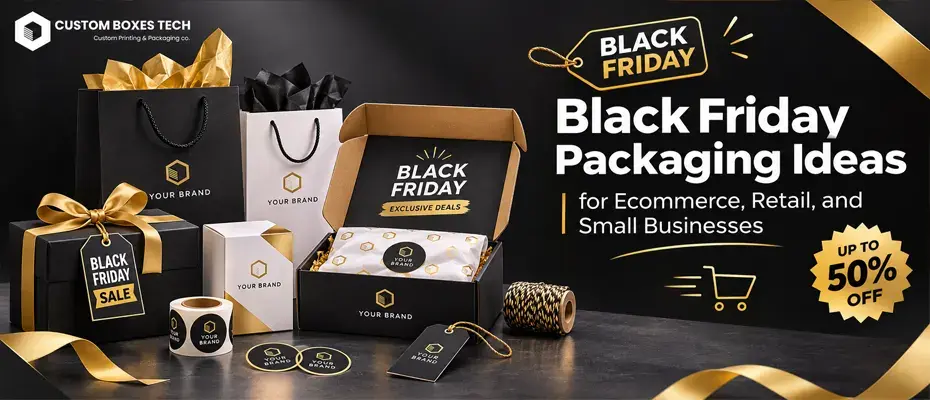
Black Friday brings many shoppers to online stores and retail shops. Businesses prepare special deals, gift sets and seasonal offers to attract buyers. Packaging also plays a key role during this busy time. It protects products, shows off a brand and creates a good first impression.
The right Black Friday packaging ideas can help a business stand out without spending too much. From printed mailer boxes to gift boxes, many styles can suit a seasonal sale. The best choice depends on the product, shipping needs, order size and budget.
Black Friday Packaging Ideas for E-Commerce Brands: 12 Creative Designs That Work
Good packaging does more than hold a product. It keeps items safe, looks neat and makes orders easy to pack. The right design can also help customers remember a business.
Here are 12 ideas for different products and sales needs.
Create Custom Branded Mailer Boxes

Mailer boxes work well for online stores that ship orders to customers. Their folding shape helps hold products in place. A printed logo or short message can also give each order a clear brand look.
You can print the outside of the box with a logo, offer or simple design. You can also add a message inside the lid. A short thank-you note can make the opening feel more personal.
These boxes suit clothing, skincare, books, gifts and small product sets.
You can add:
Full-color printing on the outside.
A message inside the lid.
Paper inserts for small items.
Matte or gloss finishes.
Simple seasonal artwork.
Explore custom mailer boxes to compare styles and sizes.
Use Black Boxes with Bright Prints
Black boxes can give a product a bold and neat look. White, gold, silver and bright colors stand out well against a dark surface. This style works for beauty items, clothing, gifts and small accessories.
A good black friday design does not need too much text. A clear logo, one short offer and a simple graphic can do the job.
Keep these tips in mind:
Choose text that people can read with ease.
Keep the logo away from folds and cut lines.
Check how light ink looks on dark stock.
Ask for a print sample before a large order.
Keep the front panel neat and clear.
Some printers add a white ink layer under light colors. This helps the print stand out on dark stock. Ask your printer to check the artwork before production.
You can also explore black mailer boxes for this style.
Add Inserts and Dividers
Inserts help stop products from moving inside a box. They also give each item its own space. This can make a gift set look neat when a customer opens it.
For example, a skincare kit may contain bottles, jars and small tools. A paper tray can hold each item in place. A candle set may need separate spaces for the candle and its lid.
Common choices include:
Die-cut paperboard inserts.
Cardboard dividers.
Fitted paper trays.
Foam inserts for items that need extra support.
Paper padding for light products.
Measure each item before you choose an insert. Leave enough room for a good fit, but do not leave large gaps.
Add QR Codes to Your Packaging

A QR code can link a box to an online page. Customers can scan it to view a deal, read a product guide or find more items.
For example, a clothing box can link to care tips. A gift box can lead to a page with matching products. A small card can also share a special offer.
Follow these steps before you print a code:
Open the link and check that it works.
Test the code on different phones.
Use dark print on a light background.
Make the code large enough to scan.
Keep the link active during the sale.
Place the code on a flat panel. Avoid folds and curved areas that may make scanning hard.
Use Printed Sleeves and Stickers
You do not always need a new box for a seasonal sale. Printed sleeves and stickers can give your regular boxes a fresh look.
A paper sleeve can wrap around a plain box. A sticker can show a special offer or a short message. Both options help small businesses change their packaging without a full redesign.
This idea also helps businesses save storage space. They can keep plain boxes in stock and order seasonal sleeves or labels when needed.
For a neat fit, match the sleeve size to the box. Keep the main message short and easy to read.
Pack Gift Sets in Rigid Boxes
Rigid boxes suit gifts and products that need a premium look. They use thick paperboards and hold their shape well. Many businesses choose them for jewellery, beauty products, gifts and small accessories.
You can choose from three common styles:
Two-piece boxes: A separate lid and base.
Magnetic boxes: A hinged lid with a magnetic close.
Drawer boxes: A sliding tray that holds the product.
You can also add:
Matte or gloss lamination.
Gold or silver foil.
Raised logos.
Soft-touch coating.
Custom paper or foam inserts.
These boxes cost more than many folding cartons. Choose them when the product price and gift value support the extra cost.
Explore rigid boxes for gift and premium packaging.
Add Counter Display Boxes to Retail Stores
Counter display boxes help stores show small products near checkout areas. Customers can see the items and pick them up with ease.
They work well for samples, snacks, cosmetics, small gifts and accessories. A printed front panel can show a short offer. A raised back panel can show the product name or main message.
Useful features include:
Open fronts.
Raised back panels.
Product dividers.
Easy-open outer covers.
Printed side panels.
Check the weight of all products before you choose the display size. The tray must hold the items without bending. Also make sure customers can take products out with ease.
See counter display boxes for retail options.
Choose Folding Cartons for Small Products
Folding cartons suit many retail products. They use paperboard and ship flat before assembly. This makes them easy to store before use.
You can use them for cosmetics, small electronics, gifts and accessories. Their panels give you room for a logo, product details and short messages.
Common styles include:
Straight tuck-end cartons.
Reverse tuck-end cartons.
Auto-bottom cartons.
Sleeve cartons.
Window cartons.
Measure the product and any inner tray before you order. A folding carton may not offer enough protection for parcel shipping. In that case, place it inside a strong outer box.
Use Corrugated Boxes for Safe Shipping
Corrugated boxes help protect products during storage and delivery. They have a fluted layer between flat paper sheets. This layer adds strength and helps the box handle daily use.
Choose the board based on the product weight, box size and shipping needs. A light item may need less support than glass or a large product set.
Check these points:
Choose the right board strength.
Match the box size to the packed product.
Add inserts for fragile items.
Close all flaps with care.
Leave room for needed padding.
A box that is too large may need more filler. It may also raise shipping costs. A box that is too small can press against the product.
Explore custom shipping boxes for different shipping needs.
Make Product Bundles Look Neat
Product bundles can offer more value to buyers. But the items need a neat layout inside the box. Loose products can move around and may look messy.
A fitted tray or divider can give each item its own space. You can also add tissue paper, a product card or a short note.
A gift bundle may include:
One main product.
Two small accessories.
A printed product card.
A thank-you note.
A fitted insert.
Place all items in their final positions before you measure the box. This helps you choose the right size and avoid extra space.
Make Boxes Easy to Open and Close Again
Some customers may return or exchange an item. A box with an easy-close design can help them pack the item again.
You can add a second adhesive strip, a resealable tab or a simple closing flap. Choose a style that suits the product and return process.
This option works well for clothing, shoes and other goods that customers may return. It does not mean every box needs a second use. It simply makes opening and repacking easier.
Use Seasonal Designs Beyond Black Friday
A box with a short-term design may leave extra stock after the sale. You can lower this risk with a design that works for more than one event.
For example, keep your logo and main colors on the box. Add a seasonal sticker or sleeve for the sale. You can remove that extra part after the campaign.
When you design Black Friday packaging, think about how you can use the same box later. A simple base design can also work for holiday sales and other offers.
How to Choose Packaging for Different Businesses
Each product needs a box that fits its size, weight and use. A box that works for clothing may not suit glass items or retail displays.
Use this table as a guide.
Business type | Suggested box | Useful features |
Clothing | Mailer boxes | Tissue paper and printed cards |
Cosmetics | Folding cartons or rigid boxes | Trays and clear product details |
Jewellery | Small rigid boxes | Fitted inserts and foil |
Candles | Corrugated boxes | Dividers and paper padding |
Electronics | Corrugated shipping boxes | Strong inserts and a close fit |
Food gifts | Suitable food cartons | Safe materials and secure closing |
Retail stores | Counter display boxes | Open fronts and printed headers |
Subscription boxes | Custom mailer boxes | Dividers and inside printing |
Food products need materials that suit their type of contact and storage. Check the right rules before you choose the material.
Which Box Style Should You Choose?
Each box style serves a different need. Compare the options before you make a choice.

Box style | Main benefit | Best use | What to check |
Mailer box | Good look and secure close | Online orders | Product fit |
Folding carton | Light and easy to store flat | Retail products | Product protection |
Corrugated box | Strong outer support | Parcel shipping | Board strength |
Rigid box | Premium look | Gifts and luxury goods | Higher cost |
Counter display box | Easy product access | Retail checkout | Weight and balance |
Paper sleeve | Quick seasonal update | Existing boxes | Correct fit |
Do not choose a box only because it looks good. Check the size, material, close and main use.
Build the Packaging Around the Full Order
The same product may need a different pack when it ships alone, joins a gift set or sits on a retail shelf. Choose the inner presentation pack and the outer shipping pack together. This helps you protect the product without paying for a box that does two jobs poorly.
Order type | Suggested packaging setup | What to check |
Single, light ecommerce item | Right-sized corrugated mailer; add a paper insert if needed | Product fit, sealed parcel weight and packing time |
Fragile glass or candle item | Corrugated shipper with a fitted divider and suitable cushioning | Movement inside the box and space around the product |
Mixed-product bundle | Mailer or shipper with a divided tray | Each item has its own space and does not hit another item |
Premium gift sent by parcel | Rigid presentation box inside a protective corrugated shipper | Keep the gift box clean while the outer box takes transit wear |
Retail carton sent to a customer | Folding carton inside an outer shipping box | The carton looks good on the shelf and the shipper protects it |
A folding carton or rigid gift box may present the product well, but it may need an outer corrugated box for parcel delivery. Treat presentation and transit protection as two separate jobs.
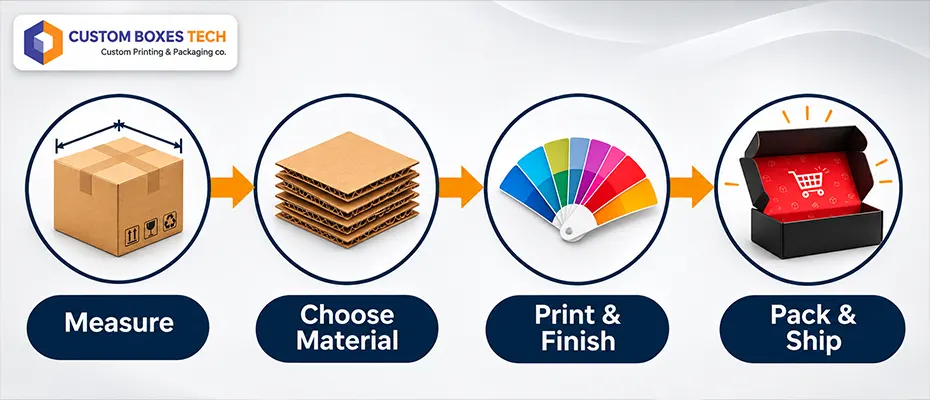
How to Choose Materials and Box Sizes
The right material can help protect a product and keep costs under control. Think about the product weight, shipping route and look you want.
Compare Common Packaging Materials
Corrugated cardboard
Corrugated cardboard has a wavy layer between two flat sheets. This layer adds strength to the box. Many businesses use it for mailers and shipping boxes.
Two common flute types include:
Flute type | Approximate thickness | Common use |
E-flute | 1.0–1.8 mm | Light products and printed mailers |
B-flute | 2.1–3.0 mm | General online orders and larger kits |
These ranges give you a starting point. The final board choice depends on the full box and packed weight.
Kraft paperboard
Kraft stock has a natural brown or white look. It works well with simple prints and clean designs. You can add logos, text and small graphics.
Rigid paperboard
Rigid board uses thick paperboard and holds its shape. It suits gift boxes and premium sets. It also needs more storage space than flat cartons.
Measure Products Before You Order
Start with the packed product, not just the item itself. Add space for trays, tissue paper and other protective parts.
Measure these three sides:
Length: The longest side of the packed item.
Width: The shorter side.
Height: The full depth of the packed item.
Use these example sizes as a guide:
Example size (inches) | Possible use |
6 × 4 × 2 | Small gifts and samples |
9 × 6 × 3 | Skincare and small kits |
12 × 10 × 4 | Clothing and gift sets |
14 × 12 × 6 | Large product bundles |
These sizes do not fit every product. Measure your items and inserts before you place an order. Ask for a sample if the fit or safety matters.
Test a Sample Before You Approve a Bulk Order
Use the real product, insert, wrap and shipping label. Check the complete pack before you approve a large run:
Fit: The product should not move freely or press hard against the box walls.
Closure: Flaps and tabs should close without force. Tape should seal the box flat.
Protection: The insert should hold the product without rubbing, crushing or blocking the closure.
Parcel size and weight: Record the outside dimensions and the weight of the sealed package.
Packing time: Time how long it takes to build, fill, close and label the package.
For fragile or high-value goods, ask the supplier or a qualified test lab about a suitable distribution test. A simple hand check can reveal fit problems, but it is not a certified transit test.
Printing and Finishing Options for Better Packaging
Good print work helps people read your message and spot your product. Choose a print method that suits your design, order size and material.

Choose the Right Printing Method
Printing method | Best for | Main benefit |
Digital printing | Small orders and detailed art | Easy design changes |
Offset printing | Large orders and fine prints | Clear, steady print results |
Flexographic printing | Some corrugated orders | Good for simple prints at scale |
CMYK printing uses four ink colors: cyan, magenta, yellow and black. Printers mix these colors to create full-color artwork.
PMS color matching helps printers match a chosen spot color. It can help when a logo needs a close color match.
Ask for a print proof before you approve the order. Check the logo, text, colors, folds and cut lines. This step can help you spot errors early.
Choose a Finish That Fits Your Design
A finish can change the look and feel of a box. You do not need to use many finishes on one design.
Finish | What it does | Best use |
Matte lamination | Gives a smooth, low-shine look | Simple designs |
Gloss coating | Adds shine | Bright prints |
Soft-touch coating | Feels smooth to the touch | Gift boxes |
Spot UV | Adds shine to chosen areas | Logos and key details |
Foil stamping | Adds a metal look | Premium gifts |
Embossing | Raises part of the design | Logos and short text |
Debossing | Presses a design into the surface | Simple brand marks |
Use one or two key effects. Too many can make the box look busy.
How Much Does Custom Black Friday Packaging Cost in the USA?
Box prices depend on size, material, print, finish, inserts and order quantity. A larger order may lower the price per box. But it also needs more money and storage space.
The table below shows published starting prices from one US packaging manufacturer. These are price-list examples, not a market average or a final quote. The supplier states that it manufactures in Dallas, Texas, and sets different minimum quantities for each product.
Packaging type | Price per unit at 500 | Price per unit at 1,000 |
E-flute mailer boxes | $3.60 | $3.17 |
Custom shipping boxes (one-color print) | $3.25 | $2.86 |
Countertop / PDQ displays | $6.75 | $5.94 |
Rigid boxes | Not listed (1,000 minimum) | $7.95 |
Printed folding cartons | Not listed (1,000 minimum) | $3.50 |
The listed minimum is 500 for the mailer, shipping and countertop display products, and 1,000 for rigid boxes and printed folding cartons. A separate mailer-box listing shows estimates of $2.39 per unit at 500 and $2.08 at 1,000, but says the final price depends on the exact specifications. View the published US price list or compare a separate mailer-box estimate. Prices were checked on 19 November 2026 and may change. Compare quotes only when dimensions, board, print, finish, inserts, quantity and delivery terms match.
What Can Change the Final Price?
Several things can change your final packaging cost:
Box size: Large boxes need more material.
Board strength: Heavy items may need stronger stock.
Printing: Full-color prints may cost more than simple prints.
Finishing: Foil and special coatings add extra cost.
Inserts: Trays and dividers need more material and work.
Order size: The price per box may change with quantity.
Delivery: Shipping cost depends on the order and delivery area.
There is no single add-on price that applies to every box. Ask the supplier to price each finish for your box size, material and order quantity. These are the main details that affect the quote:
Finish | What affects the quote |
PMS color matching | Number of spot colors and print area |
Matte or gloss lamination | Board stock and the surface area covered |
Soft-touch coating | Coating coverage and material compatibility |
Spot UV | The area covered and the setup required |
Foil stamping | Foil area, die size and order quantity |
Embossing or debossing | Die complexity and the size of the raised or pressed area |
Ask for finishes as separate line items on the written quote. This makes it easier to see which upgrade adds value and which one only adds cost.
Work Out the Cost Per Order
A low box price does not always mean a low total cost. Add the cost of all parts and delivery before you choose a supplier.
Example:
For a simple example, assume a written quote gives a price of $2.50 per box for 1,000 boxes. This is a hypothetical figure to show the calculation, not a supplier price.
Cost item | Illustrative amount |
1,000 boxes at an assumed $2.50 each | $2,500 |
Inserts (example) | $150 |
Printed cards (example) | $75 |
Delivery (example) | $125 |
Total | $2,850 |
If each order uses one box, one insert and one card, the example total comes to $2.85 per order ($2,850 ÷ 1,000). Replace these sample amounts with your own written quote.
This example helps you plan. Your supplier may give you a different price.
How to Cut Packaging Costs Without Losing Quality
You can save money without making every box plain or weak.
Try these steps:
Use standard box shapes: Add custom art to a simple box.
Limit special finishes: Use foil or spot UV only where it adds value.
Keep fewer box sizes: This can make storage and packing easier.
Use seasonal sleeves: Give old boxes a fresh look.
Pick the right board: Do not pay for extra strength that you do not need.
Plan order sizes: Compare savings with storage costs and demand.
Test a sample: Find size and print issues before a large order.
Also use right-sized packaging. A close fit can cut extra filler and save space. It may also help lower shipping costs when a carrier uses dimensional weight to price a parcel.
When Should You Order Packaging for Black Friday?
Custom packaging needs time for design, proof checks, production and delivery. Start early so you have time to fix any issues.
Use this plan as a guide:
Time before Black Friday | What to do |
8–12 weeks | Plan sales needs and choose box styles |
6–8 weeks | Check sizes, materials and artwork |
4–6 weeks | Review proofs and test samples |
2–4 weeks | Check production and delivery plans |
1–2 weeks | Count stock and set up packing areas |
This timeline gives you a starting point, not a promise. Some suppliers may need 7–14 business days after artwork approval. Sample changes, shipping and busy periods can add more time.
Pricing and specification note: We checked the public supplier price pages linked above on 19 November 2026. Prices are examples only and can change. Approve a sample made to your final specification before you place a bulk order.
Prepare Your Packing Station for Peak Orders
A good box can still slow a team down if staff cannot find the right size or insert. Before the sale starts:
Keep the two or three most-used box sizes close to the packing area.
Place the matching inserts, cards, tape and labels beside each box size.
Mark shelves with the box's inside dimensions so staff can pick the right one quickly.
Run a short trial with sample orders and note packing time, loose fill and fit problems.
Set a stock reminder before the busiest sales days.
Start even earlier for large orders or complex rigid boxes. Confirm the full timeline with your supplier before you pay.
Common Packaging Mistakes to Avoid
A nice design can still cause problems if the box does not fit the product. Watch out for these common mistakes:
Wrong box size: A loose box lets items move. A tight box can press on them.
Weak material: Pick board that suits the product weight and delivery needs.
Too much text: Keep the main offer clear and easy to read.
No print check: Screen colors may look different from the final print.
Late orders: A delay can leave little time for changes.
Too much stock: Extra boxes take up space and tie up money.
Unclear green claims: Only make claims that the material and local recycling rules support.
Check the full package before you approve it. Look at the box, insert, print, close and shipping needs together.
Black Friday Packaging Checklist for Businesses
Use this list before you place an order:
☐ Plan the number of orders you expect.
☐ Pick the products that need special boxes.
☐ Measure each packed product.
☐ Choose the right box style.
☐ Check the board type and strength.
☐ Select a print method.
☐ Pick colors and finishes.
☐ Check the artwork and print proof.
☐ Test a sample with the real product.
☐ Confirm the full price and delivery date.
☐ Count your stock before the sale starts.
A clear packaging checklist can help you avoid last-minute changes and keep your order on track.
Get Your Packaging Ready for the Next Black Friday Sale
Good packaging does more than carry a product. It helps your business show its products, protect orders and give customers a good first look. The right box can also make packing and storage easier during busy sales weeks.
Start with your product sizes, order needs and budget. Then compare box styles, materials, prints and finishes. Test a sample before you order in bulk.
For help with custom packaging, call 1 (888) 247-7075 or email support@customboxestech.com. Share your product size, order quantity and design needs to discuss the right option.
FAQs
What Is the Inexpensive Packaging for Black Friday Orders?
Plain corrugated boxes with simple prints or stickers can help lower costs. You can also use your current boxes with new sleeves or labels. Compare the full cost of the box, print, inserts and delivery.
How Can Small Businesses Create Seasonal Packaging?
Small businesses can create seasonal packaging by following these steps:
Choose an occasion: Select Christmas, Valentine's Day, Easter or Mother's Day.
Set a budget: Plan your design, printing and material costs.
Update existing boxes: Add seasonal stickers, ribbons or printed sleeves.
Choose suitable colors: Match your artwork with the occasion.
Request a sample: Check the design, size and quality before ordering.
Plan production early: Allow enough time for printing and delivery.
Order wisely: Match packaging quantities with expected seasonal sales.
Which Material Works Best for Shipping Boxes?
Corrugated cardboard works best for most shipping boxes because it offers strength, cushioning and protection during transportation. The right thickness depends on product weight, fragility and shipping distance.
Popular options include:
Single-wall corrugated board: Suitable for lightweight products and regular parcel shipping.
Double-wall corrugated board: Offers extra strength for heavy or fragile products.
Triple-wall corrugated board: Suitable for very heavy goods and demanding shipping conditions.
Kraft corrugated board: Provides a strong structure with a natural brown appearance.
Recycled corrugated board: Offers a paper-based option for businesses seeking to use recycled materials.
Our recommendation: Choose single-wall board for standard shipments and double-wall board for heavier or fragile products. Add protective inserts, paper cushioning or other suitable padding to prevent movement during transit. Always check the box strength rating before ordering.
How Early Should I Order Custom Boxes?
Start planning 8–12 weeks before the sale if you can. This gives you time to check sizes, review samples, approve artwork and arrange delivery. Always ask your supplier for a clear timeline.
Can I Use My Current Boxes for Black Friday?
Yes. Add a sleeve, sticker or printed card to give your current boxes a new look. This works well when your regular boxes already fit the products.
What Should I Put Inside a Black Friday Box?
You can add a thank-you card, care guide, product tips, offer card or fitted tray. Pick items that help the customer or improve the order. Do not add extras just to fill space.